
Robot Intelligence lets an autonomous mobile robot judge a changing situation for itself instead of following pre-written commands, but a decision only becomes work once the drive system carries it out. This article looks at how next-generation Robot Intelligence is being applied to AMRs, what the wheel drive actuator has to deliver in a logistics setting, and how the Bonsystems BCSA balances slim packaging with driving performance.
Contents
What would happen if robots gained a brain that could think for themselves, the way humans do? Until now, robots have needed pre-written code just to carry out a single motion. Developers would set in advance which actions the robot should perform in anticipated situations, and the robot would simply move according to those programmed commands.
However, as cutting-edge technologies like artificial intelligence have advanced rapidly, Robot Intelligence has emerged as a new field. AI for robots refers to AI models that recognize their surroundings and objects, form a plan of action, and then move according to the plan they themselves have set.
Robot Intelligence is being applied across a range of robot platforms, including humanoids, AMRs, and six-axis robots, as its real-world viability continues to be tested. Among these, autonomous mobile robots (AMRs) deserve particular attention. In this piece, we’ll look at how Robot Intelligence is actually being used in AMRs, and explore the actuator technology that translates the AI’s decisions into a robot’s physical movement.
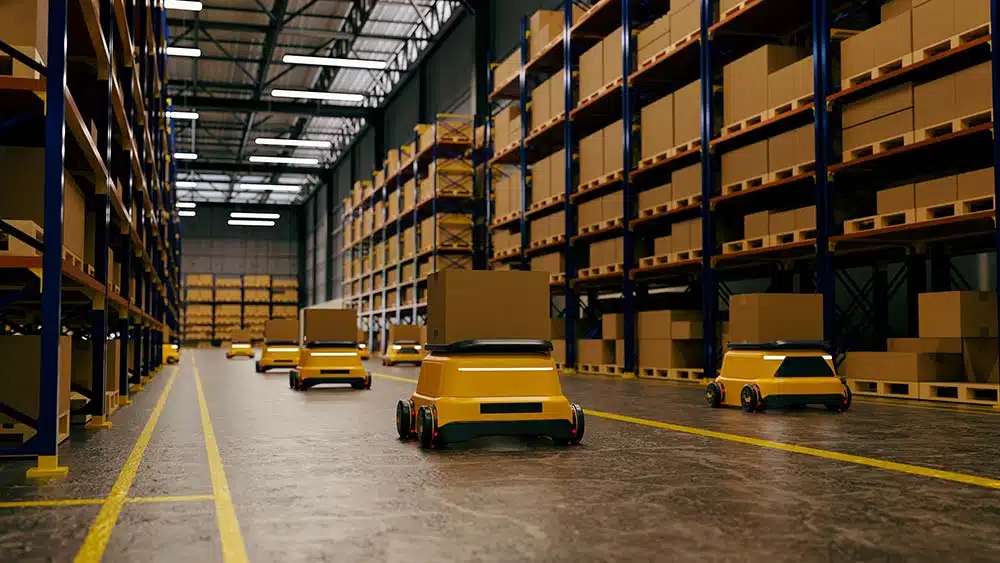
Next-Generation Robot Intelligence Applied To AMRs
An autonomous mobile robot (AMR) is an intelligent robot that can perceive its external environment, judge the situation, and travel to a destination without relying on a fixed guide path. It represents a further evolution beyond automated guided vehicles (AGVs), which require a set route marked with QR codes or rails on the floor.
Given that description, it might already sound as if AI is built into AMRs. And indeed, autonomous mobile robots do make judgments and move based on onboard sensors and intelligent software. Layering next-generation Robot Intelligence on top of this raises autonomy even further, to a level where the robot can judge and respond to a wide range of variables on its own.

Next-generation Robot Intelligence achieves this through reinforcement learning. In this approach, the robot interacts directly with its environment and learns the most effective judgment through trial and error. An AMR has to recalculate its set path whenever it runs into an unexpected obstacle or a person moving nearby. Next-generation AI uses repeated reinforcement learning to shorten this process and respond instantly.
Taking this further, the robot can recognize its entire operating space and grasp its surroundings in real time. It can identify not only its own current position but also the layout of nearby structures and the positions of other robots, and use that awareness to plan a route suited to the task at hand.
In this way, Robot Intelligence allows for far more flexible responses to changing conditions. Robot AI technology is currently at the stage of being validated for field deployment, and full commercialization will also require technology that can translate the AI’s decisions into actual physical work. That is where the robot’s drive system technology comes in.

What Does An AMR Need From Its Actuator?
A robot’s drive system is made up of various components, and among them, the actuator plays the core role of turning decisions into actual movement. In an autonomous mobile robot, the actuator is applied to the wheel drive unit, generating the driving force needed for travel and helping support stable movement.
Because AMRs carry and move cargo repeatedly throughout the day, it’s important for the actuator to deliver strong torque output. In particular, if sufficient torque isn’t available during acceleration, deceleration, or direction changes, situations that demand a great deal of driving force, driving stability can suffer. Since these motions repeat over long periods, the actuator also needs the durability to maintain stable performance under continuous use.
AMRs also pack sensors, batteries, and control units together in their lower section, which makes the actuator’s size and shape an important design consideration as well. AMRs frequently navigate narrow passages or work alongside other equipment, so if the drive unit becomes too large, it can affect the robot’s overall size and structure. A design that keeps the drive unit compact while still delivering the required driving performance is therefore essential.

The BCSA Series: Balancing Space Efficiency And Driving Performance
Bonsystems’ BCSA actuator is a drive solution built to meet these requirements, delivering strong torque in a slim, thin profile. Using a thinner actuator reduces the space the drive unit takes up inside the robot, freeing up room elsewhere. That extra space can then be used to arrange components like sensors and batteries more efficiently and to design cleaner wiring layouts between parts.
Autonomous mobile robots, in particular, travel repeatedly across multiple zones while their load constantly changes, which can lead to significant power consumption. Having enough space to expand battery capacity can help reduce downtime for charging and improve overall work efficiency.
The BCSA also draws structural stability from its cycloidal reduction design, allowing it to maintain driving performance even over long hours of operation. In a cycloidal structure, the load is distributed across the tooth contact surfaces rather than concentrated in one spot, which eases the burden placed on the drive unit. This structural characteristic is well suited to delivering stable performance in environments with continuous loads or external impacts.


Altogether, the BCSA actuator is a robot actuator solution that combines a slim design with strong torque output to give autonomous mobile robots greater design freedom, along with the durability that comes from its cycloidal structure.
As Robot Intelligence technology continues to advance, robots capable of taking on human roles are steadily becoming a reality. For that to happen, robots will need to carry out AI-driven decisions both reliably and quickly, and the importance of drive technology that can adapt to a wide range of changing environments is expected to grow alongside it.
We tailor our product offerings to each customer’s robot design and requirements. If you’re evaluating actuator solutions for logistics robots, or have questions about the BCSA actuator, feel free to reach out through our website.

F.A.Q
Q: What defines an AMR, and how does it decide where to travel?
A: An AMR uses sensors and software to understand its surroundings and decide its own route, rather than following a preset path marked on the floor. Because of this, AMRs are mainly used in logistics environments where the work setting changes frequently or travel routes need to stay flexible.
Q: What changes when next-generation Robot Intelligence is introduced to an AMR?
A: The robot can respond more flexibly to a changing work environment. Reinforcement learning in particular allows the robot to improve its decision-making based on experience across a variety of settings, helping it achieve more autonomous navigation in complex, unpredictable logistics environments.
Q: What role does the actuator play in an autonomous mobile robot?
A: The actuator, made up of components such as a reducer and motor, generates torque internally to drive the AMR’s movement. It delivers the torque needed for the robot’s load and driving conditions, enabling a range of movements including starting, stopping, accelerating, decelerating, and changing direction.
Q: How does actuator thickness affect AMR design?
A: A smaller actuator frees up room inside the robot for other components. This is especially valuable when battery capacity, sensor layout, or wiring paths need to be considered, since efficient use of internal space benefits the overall design.
Q: Why is a cycloidal structure well suited to AMRs?
A: A cycloidal reduction design distributes force across the tooth contact surfaces, allowing for stable operation even in environments with repetitive driving cycles. For equipment like AMRs, which undergo continuous travel and frequent direction changes, this characteristic helps support the durability and stability of the drive unit.
