
A home is not a standardized workspace, so a domestic robot has to be shaped around furniture, walkways, and tight corners before anything else. This article looks at how far home robot technology has come, why compact size and sufficient output are hard to hold together in one actuator, and how the Bonsystems BCSA V4 uses a cycloidal reduction structure to free up design space.
Contents
At first glance, robots tend to look rugged, built to move heavy loads without much trouble. In industrial settings, that impression holds up: robots there repeat fixed tasks and need to deliver force reliably every time. That’s why the components used inside these robots have traditionally been built around strong torque output that can support repeated operation.
But as robots move beyond factories and into everyday life, the requirements placed on them are shifting. It’s no longer enough to simply produce strong force. What matters more now is design flexibility, the ability to shape a robot’s form and internal structure around a wide range of environments and purposes.
This shift is especially visible in the growing development of domestic robots meant to take on household tasks. From basic cleaning to cooking, organizing, and carrying objects, the range of jobs a robot might handle at home is broad. As interest in the home robot market grows, building a form and structure suited to real household environments has become a critical design challenge for bringing these products to market.
This article takes a brief look at the types of home robots currently in development and examines what conditions the actuators inside them need to meet in order to operate smoothly.
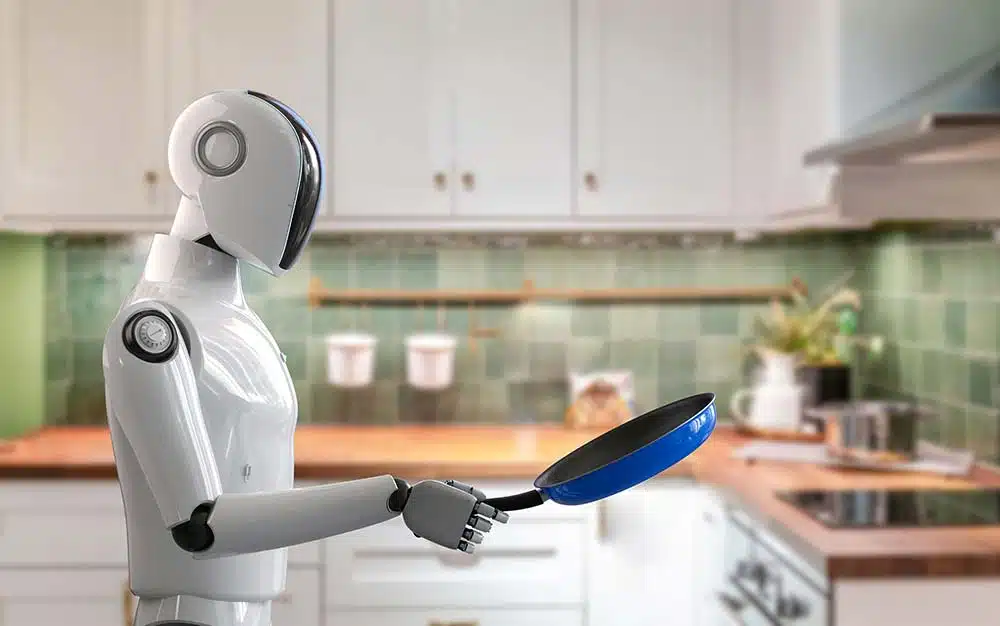
How Far Has Domestic Robot Technology Come?
Home robots are already part of daily life in many ways. Robot vacuums are the clearest example, reaching under furniture and into tight corners that are hard for people to clean by hand. More recently, the technology has moved beyond this kind of repetitive movement toward tasks that require the kind of delicate motion found in human hands, steadily expanding what these robots can do.
A UK-based robotics company is developing a robot that can carry out a range of cooking tasks within a confined space like a kitchen. Built into the kitchen system itself, the device uses two robotic arms to cook, gripping and handling kitchen tools much like a human arm would while carrying out complex, combined tasks.

At the same time, humanoid-style domestic robots designed to handle everyday chores are becoming more of a reality. A US robotics startup is developing a robot that can fold laundry in unfamiliar environments without remote operation or preprogrammed movements. Even when the laundry shifted or its motion was disrupted mid-task, the robot was able to assess the situation on its own and continue working, maintaining a high success rate across repeated trials in a variety of household settings.
Real-world environments obviously involve far more variables than test conditions, and plenty of technical challenges remain. Still, the steady pace of testing and development aimed at realistic living conditions, as seen in the examples above, shows that commercial home robots are gradually becoming less of a distant prospect.

Why Compact Size And Sufficient Output Are Hard To Combine In An Actuator
Domestic robots need to be designed with space efficiency in mind, minimizing interference with their surroundings and moving smoothly even in tight quarters. Homes require accounting for interior layouts, furniture placement, and the paths people move through.
Achieving a compact exterior also means the components inside the robot need to be small enough to fit within that limited space. The actuator, which plays a central role in the drive system, closely affects the overall design of the robot.
Actuators are the components responsible for actually generating movement, applied at joints in a robotic arm or in wheel assemblies. Inside, a motor produces fast rotational motion, and a reducer converts that rotational force into the torque and speed the robot needs for its tasks.

To draw strong torque output from an actuator, engineers typically turn to a larger motor for more power, or thicken the gear structure of the reducer so it can withstand a heavier load. The problem is that as the actuator grows in size, it takes up more space inside the robot, sometimes forcing the robot’s overall form to be designed around the size of that one component.
BCSA V4: Built For The Design Flexibility Domestic Robots Need
Bonsystems set out to address this exact design challenge with the BCSA V4 series, built for robots operating under space constraints. Based on a proprietary cycloidal reduction structure, BCSA V4 reduces actuator shaft thickness, achieving a compact, lightweight drive solution.
The joints of a robotic arm or humanoid are already crowded with sensors, controllers, and other components alongside the actuator. When the actuator takes up a large share of that space, there’s less room left for other parts, and the wiring and connections between components become more complex to design. Applying a slim BCSA actuator reduces the volume taken up by the drive system, which accounts for a large portion of a robot’s internal space, easing the burden on designers.

Of course, shrinking the drive system doesn’t help much if torque output suffers as a result, since the robot still needs enough driving force to function. That’s why the BCSA series relies on a cycloidal tooth profile designed to deliver strong torque even within a slim structure. This profile has a distinctive curved shape with strengths in torque output and load distribution.
Because a cycloidal gear structure transmits power through surface contact across the tooth profile, the shocks and loads generated during operation get distributed across the whole gear rather than concentrated in one place. This helps reduce strain on the drive system and keep torque output stable, even during long hours of repetitive work or under heavy loads.
The distinguishing feature of the BCSA V4 is that, in addition to the load-distribution characteristics of its cycloidal structure, it combines a slim form factor with a wide reduction ratio. BCSA delivers the strong torque a robot needs from a single-stage structure while staying slim, with no extra design steps required.
Taken together, the BCSA V4 series’ slim structure and strong torque output make it a drive solution that broadens the design options available for equipment where internal space really matters, from robotic arms to wheel drive systems.

Domestic robots are a field where technology keeps advancing, aimed at improving quality of life by taking on the household chores that repeat day after day. As home robot development continues to expand, demand is expected to grow for drive components that are compact yet deliver sufficient performance.
We develop actuators for robots used in industrial and humanoid applications, offering a wide product lineup and proposing drive solutions tailored to each customer’s specific requirements. If you have questions about the BCSA V4 series or want to explore how it might fit into a robot you’re developing, please reach out through our website.
F.A.Q
Q: How Are Domestic Robots Evolving?
A: Early home robots mostly handled repetitive movement tasks, like robot vacuums, and the technology has since moved toward tasks that were previously hard to automate. Folding laundry, for instance, looks simple but is difficult to engineer, since the shape of the object keeps changing and careful force control is required.
Q: Does A Smaller Actuator Make It Harder To Produce Strong Torque?
A: Actuators need to be a certain size to deliver sufficient performance. Since a motor, reducer, and other components all sit inside the actuator, higher torque requirements or the need for greater durability tend to call for larger internal parts, so finding the right balance between actuator size and torque output is key.
Q: Why Does Space Efficiency Matter So Much In Home Robot Design?
A: Homes are filled with furniture and everyday items, which leaves limited room for a robot to move and operate. If a robot’s drive system is too large or protrudes too much, it can restrict movement and raise safety concerns, so a compact, slim drive system is essential for a robot to work in tight indoor spaces.
Q: What Advantage Does BCSA’s Slim Structure Offer For Domestic Robot Design?
A: In robotic arm-style home robots or humanoids, where motors, sensors, and wiring are all packed around the joints, the size of the drive system can shape the entire design. A slim BCSA actuator makes more efficient use of limited internal space, helping reduce interference between components and giving designers more freedom.
Q: What Information Is Helpful To Have Ready When Inquiring About Actuator Products?
A: It helps to know in advance what type of robot is being developed, where the actuator will be installed, and what torque is required. Sharing details like the available installation space also makes it easier to quickly identify suitable products and drive specifications.
