
Table of Contents
- Why Robotic Hands Matter in Humanoid Robots
- Robotic Hand Actuation Methods
- The Need for Miniaturized Reducers and Actuators
- FAQ
Why Robotic Hands Are So Challenging in the Era of Humanoid Mass Production
As humanoid robot technology continues to advance, attention is shifting from walking and mobility to the ability to perform practical tasks. In the early stages, humanoid robots attracted considerable interest simply by walking on two legs, maintaining balance, or navigating designated spaces. Today, we are seeing robots pick up and move objects, handle tools, and perform increasingly complex tasks.
For humanoid robots to work in factories, logistics centers, and service environments, they must perform tasks traditionally carried out by human hands, such as picking up components, operating tools, pressing buttons, and moving objects. Robotic hands play a critical role in enabling these capabilities.
Conventional industrial robots and automated equipment have often relied on grippers with two or three fingers to repeatedly grasp specific objects. When objects have consistent sizes and shapes, and the same task is performed repeatedly at a fixed location, relatively simple gripper designs can be sufficient.
Humanoid robots, however, must handle a wide range of objects and tools in environments originally designed for humans. Tools, household items, components, and boxes vary in size, weight, and shape, requiring different grasping positions and methods. This makes it difficult for a single, simple gripper mechanism to handle every object effectively.
To overcome these limitations, robotic hands with multiple fingers and joints capable of movements similar to those of human hands are becoming an increasingly important technology in humanoid robotics.
Why Robotic Hands Matter in Humanoid Robots
Consider how frequently people use their hands during everyday work. Lifting components, holding tools, pressing buttons, moving boxes, and opening doors all require hand movements.
Human hands do more than simply grasp objects. Multiple joints work together when changing an object's orientation or adjusting its position between the fingers. For humanoid robots to handle different objects and tools, they need to move individual finger joints and adapt their grasping methods to the shape of each object.
Recent humanoid robot demonstrations have shown robots using multiple fingers to move components, sort boxes, and operate tools. Although their speed and natural movements still differ from those of human hands, robotic hand technology continues to advance beyond basic grasping toward practical task execution.
Most existing workplaces are also designed around human hands. Tool handles, equipment buttons, switches, and door handles are sized and shaped for human operation. If robots can use these tools and environments without major modifications, the range of tasks they can perform becomes significantly broader.
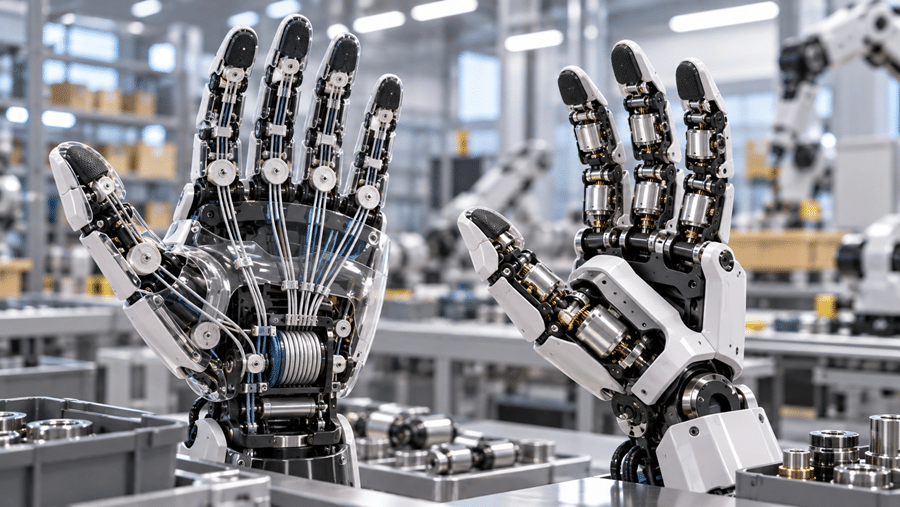
This image was generated using AI for illustrative purposes and is not related to products manufactured by BON SYSTEMS Co., Ltd.
One of the greatest challenges in robotic hand design is limited installation space. Multiple fingers and joints must fit within dimensions similar to those of a human hand, along with the drive mechanisms required to move each joint. Sensors for detecting finger positions and contact conditions, as well as power and signal cables, must also fit inside.
As the number of joints increases and finger movements become more complex, the number of components that must be accommodated within the hand naturally grows.
Robotic Hand Actuation Methods
Robotic hands use different actuation mechanisms depending on their design and intended purpose. Broadly speaking, these mechanisms can be divided into tendon-driven systems that transmit force through cables or tendons and systems that place actuators directly at or near individual joints.
In tendon-driven systems, motors are positioned in the palm, wrist, or forearm, and cables are pulled to move the finger joints. This resembles the human hand, where some muscles responsible for finger movement are located in the forearm and transmit force through tendons.
Because motors and reducers do not need to be installed inside every finger, this design allows the fingers to remain relatively lightweight and slim. It also makes more efficient use of the limited space available within each finger.
However, engineers must carefully design the cable routing and calculate the required tension. When a single actuator moves multiple joints, the mechanical structure must also be designed to achieve the desired movement ratio between joints.
Over extended periods of operation, cables may stretch or experience changes in tension, making adjustment and maintenance important design considerations.
This image was generated using AI for illustrative purposes and is not related to products manufactured by BON SYSTEMS Co., Ltd.
Another approach is to install motors, reducers, and other drive components directly at or near individual finger joints.
Handling objects of different shapes requires each finger to move through different angles and apply different amounts of force. Even within a single finger, individual joints may need to perform different movements.
By placing dedicated drive components at individual joints, engineers can operate each joint independently and achieve a wider variety of finger movements.
However, installing drive components at every joint creates additional space constraints. Motors, reducers, bearings, sensors, and cables must all fit within dimensions comparable to those of human fingers.
As drive components become larger, finger structures also become thicker. Additional weight increases the load on the actuators responsible for moving the wrist and arm.
Therefore, developing robotic hands that maintain human-like dimensions while enabling more complex joint movements requires smaller and lighter drive components.
This is why compact motors, reducers, and actuators are essential technologies in robotic hand development.
The Need for Miniaturized Reducers and Actuators
A humanoid robotic hand designed to resemble the size of a human hand must accommodate multiple finger joints, drive components, sensors, and wiring within a limited space.
Increasing the number of joints does not mean that the hand can simply become larger. If humanoid robots are expected to use existing tools and equipment, their hands must remain reasonably compatible with environments designed for human workers.
Oversized robotic hands may have difficulty operating tool handles, buttons, and switches designed for human use.
To incorporate more joints and sensors without increasing overall hand dimensions, the installation space required by each drive component must be reduced. In particular, robotic fingers require compact reducers and actuators capable of transmitting the necessary torque within extremely limited spaces.
BON SYSTEMS has developed the BSR 018 Micro, an ultra-compact cycloidal reducer with a diameter of approximately 18 mm, for use in robotic hands and other small robotic joints.
Its compact cycloidal reduction mechanism is designed for applications with limited installation space, including robotic fingers, grippers, and miniature robotic joints.
The BSR 018 Micro incorporates BON SYSTEMS' proprietary Pinless cycloidal mechanism. By reducing the number of pins and associated components used in conventional cycloidal reducers, this design simplifies the component structure and takes assembly requirements into account, even at an ultra-compact scale.
When developing miniature reducers, engineers must consider more than external dimensions. The internal mechanism must also transmit the required torque within a restricted space while maintaining practical assembly characteristics.
Building on its ultra-compact cycloidal reducer technology, BON SYSTEMS is also developing miniature actuators for robotic hands and small robotic joints.
As humanoid robots take on a wider range of tasks, robotic hands are likely to incorporate more joints and sensors. However, because hand dimensions cannot increase indefinitely, the technology used to reduce the size and weight of individual joint drive components must advance alongside these developments.
Starting with the BSR 018 Micro Reducer, BON SYSTEMS continues to develop cycloidal reducers and actuators for compact robotic joints.
The company plans to expand its robotic hand product lineup through compact drive technologies that deliver the required torque within limited installation spaces and support applications involving multiple joints.
FAQ
Q. What is the main difference between a humanoid robotic hand and a conventional gripper?
Conventional grippers are generally suited for repeatedly grasping objects of predetermined shapes. Robotic hands, on the other hand, use multiple fingers and joints to handle objects of different sizes and shapes. For humanoid robots operating in various work environments, independent finger movements and coordinated joint motions are particularly important.
Q. Why do robotic hands need multiple joints?
When people grasp an object, each finger moves through different angles and positions, while multiple joints within each finger work together. Similarly, robotic hands require multiple movable joints to grasp objects of different shapes and adjust their orientations.
Q. What types of robots can use the BSR 018 Micro?
The BSR 018 Micro is an ultra-compact cycloidal reducer with a diameter of 18 mm. It was developed for applications with limited installation space, including robotic fingers, grippers, and miniature robotic joints. Its compact structure makes it suitable for designs that require multiple drive components within a confined space, such as humanoid robotic hands.
Q. What changes when a robotic hand has more degrees of freedom?
More degrees of freedom allow fingers and joints to perform a wider range of movements, making it easier to handle objects with different shapes. However, additional joints may also require more actuators, sensors, and wiring, increasing the complexity of the internal mechanical structure.
Q. Why is it important for robotic hands to be similar in size to human hands?
If humanoid robots are expected to use tools and equipment designed for human workers, their hands must be reasonably compatible with existing work environments. Oversized hands may have difficulty operating handles, buttons, switches, and other components designed around human hand dimensions.