
Table of Contents
Can Robots Be Stronger Than Humans? What Determines a Robot's Strength?
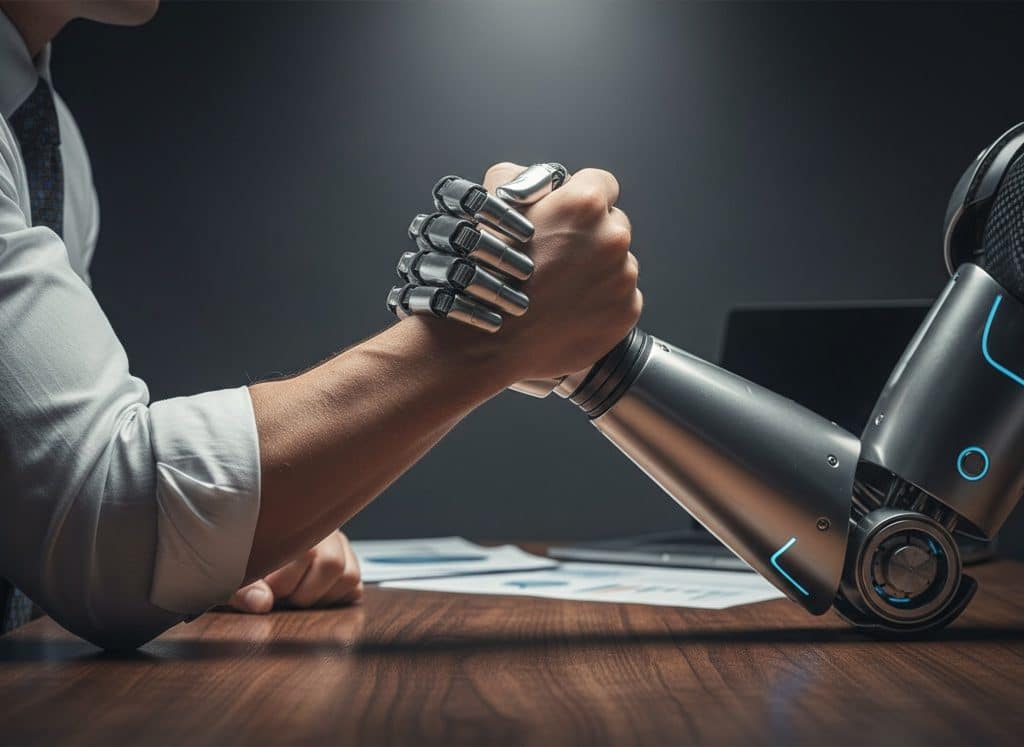
If a human and a robot competed in arm wrestling, who would win? Since some robots can generate forces greater than those of humans, the outcome would not be easy to predict.
In industrial environments, robots already perform tasks such as moving heavy components that people would struggle to lift manually or repeatedly applying large forces during manufacturing processes. Meanwhile, other robots are designed to handle small objects with movements similar to those of human hands.
The strength a robot can generate depends not only on its size but also on its mechanical structure and intended application.
So where does a robot's strength come from?
Humans generate force by contracting muscles, which work with bones and joints to produce movement. Robots do not have muscles like humans. Instead, they rely on drive systems consisting of motors, reducers, and other mechanical components.
These components convert electrical energy into mechanical motion and transmit the torque required to move robotic joints.
In this article, we will explore how motors and reducers generate and transmit torque, how these components function as the mechanical equivalent of muscles, and how reducer torque relates to the actual force a robot can exert.
Humans Have Muscles. What Do Robots Use to Generate Force?
Humans can bend their arms and lift heavy objects because muscles, bones, and joints work together.
Muscles contract in response to signals from the nervous system, generating forces that move the joints. From everyday actions such as bending an arm or extending a leg to lifting heavy objects, human movement relies on this interconnected mechanical structure.
Robots must also move joints in their arms, legs, and fingers, but they do not have the same muscular structure as humans.
Instead, they use motors that convert electrical energy into rotational motion and reducers that decrease rotational speed while increasing torque.
When a motor generates rotational power, the reducer decreases the rotational speed and increases the torque transmitted to the robotic joint.
For example, consider a motor connected to a reducer with a 20:1 reduction ratio. For every 20 revolutions of the input shaft, the output shaft completes one revolution.
Under ideal conditions, the output torque would be 20 times the input torque. In practice, however, mechanical losses in gears, bearings, and other components affect the actual output torque.
Therefore, calculating the torque available from a reducer requires consideration of both the reduction ratio and mechanical efficiency.
A device that combines motors, reducers, and other components to produce robotic motion is generally called an actuator.
Actuators are manufactured in various configurations depending on their intended applications. In addition to motors and reducers, they may incorporate encoders, brakes, and control electronics.
Rotary actuators are widely used in robotic joints, including shoulders, elbows, wrists, and knees.
Just as the size and function of human muscles vary across different parts of the body, the drive performance required by robotic joints also differs.
Leg joints supporting heavy loads may require high torque, while finger joints designed to manipulate small objects need compact drive components that can fit within limited spaces.
For this reason, selecting motors and reducers according to each joint's function and intended task is an essential part of robot development.
Does Higher Torque Always Mean a Stronger Robot?
When examining motor and reducer specifications, engineers frequently encounter the unit Nm (newton-meter).
This is the unit of torque, which describes the turning effect of a force around a rotational axis.
Under otherwise identical conditions, a joint capable of generating greater torque can generally handle a larger load.
However, even when two robots use drive components with identical torque ratings, the actual force they can exert may differ depending on the length of their arms, the positions of their joints, and the direction in which force is applied.
In multi-joint robots, individual joint torques interact with the robot's overall posture and mechanical configuration.
As a result, the torque rating of a reducer alone is not sufficient to determine the robot's overall working capability.
Want to know how to calculate motor and reducer torque?
Even if a reducer is designed to transmit high torque, it cannot deliver that output unless the motor provides sufficient input torque.
Conversely, if the motor generates torque beyond the reducer's allowable limits, the reducer may experience excessive mechanical loads.
Therefore, the output torque available at a robotic joint depends on the performance and operating limits of both the motor and reducer.
Reducer torque is an important factor in determining robot strength, but a higher torque rating does not automatically mean that a robot will exert greater force in every application.
To evaluate a robot's actual working capability, engineers must examine how joint torque is transmitted through the robot's mechanical structure and whether the required movements can be performed reliably.
Why Reducers Matter When Building Stronger Robots
For a robot to lift heavier objects or perform tasks requiring greater force, its joints must generate sufficient torque.
Engineers may consider using a larger motor or increasing the reduction ratio to achieve higher output torque.
However, robotic joints have physical limitations in terms of installation space and allowable weight. Simply increasing the size of the drive system is not always a practical solution.
In robotic arms, the weight of the drive components also affects the torque requirements of other joints.
For example, adding weight to the wrist or elbow actuator may increase the load that the shoulder joint must support.
When the arm is raised, gravitational loading can increase depending on its position. Rapid acceleration or deceleration can also generate additional inertial loads.
As these loads increase, joints closer to the robot's base may require motors and reducers with higher output capabilities.
Conversely, reducing the size and weight of drive components while maintaining the required torque can make it easier to manage the robot's overall weight.
It can also provide additional space for arranging internal components and routing cables, giving engineers more flexibility when designing the robot's external form and mechanical structure.
For these reasons, selecting a robotic reducer requires consideration of more than its torque transmission capacity.
Engineers must also evaluate outer diameter, thickness, weight, and structural rigidity.
Increasing the reduction ratio can produce greater output torque from the same motor input torque, but it also decreases the output rotational speed.
Balancing the required torque with the desired movement speed is therefore another important part of drive system design.
The BSR cycloidal reducer series from BON SYSTEMS is designed with these robotic drive requirements in mind.
Based on the company's proprietary cycloidal tooth profile technology, the BSR series is engineered to transmit high torque within a slim structure.
Its compact dimensions and hollow-shaft configuration are intended to accommodate the limited installation space available inside robotic joints.
Ultimately, developing robots capable of generating greater force requires engineers to consider not only motor output and reducer performance but also the overall dimensions and weight of the drive system.
The goal is to achieve the required torque within the available joint space while configuring a drive system suited to the robot's intended tasks.
The force a robot can exert depends on several interconnected factors, including motor output, reducer torque transmission, joint structure, drive component dimensions and weight, and operating conditions.
This is why engineers must select drive components that provide sufficient torque while meeting the mechanical and functional requirements of the robot.
If you are evaluating reducer torque, reduction ratios, installation space, or drive system configurations for a robotics project, explore the BON SYSTEMS product lineup.
Our team can discuss reducer and actuator specifications suited to your application and the requirements of individual robotic joints.
FAQ
Q. Which components function as muscles in a robot?
In robots, drive systems consisting of motors, reducers, and other mechanical components perform functions similar to those of human muscles. Motors generate the rotational power required for movement, while reducers adjust rotational speed and torque before transmitting power to the joints.
Actuators that integrate these components are used to move robotic arms, legs, wrists, and other joints.
Q. Can a robot lift heavier objects if its reducer has a higher torque rating?
Generally, higher available joint torque can improve a robot's ability to lift heavier objects. However, the actual payload capacity depends on motor output, robotic arm length, joint position, and mechanical structure.
Therefore, a reducer's torque rating alone cannot determine a robot's maximum payload capacity.
Q. Why are small and lightweight reducers important for robotic joints?
The weight of drive components affects both the robot's overall mass and the loads experienced by other joints.
In particular, heavier components installed near the end of a robotic arm may increase the torque required from joints closer to the base.
Reducing reducer size and weight while maintaining the required torque is therefore an important consideration in robotic design.
Q. Can different reducers be used within the same robot?
Yes. Different robotic joints perform different functions and have different torque requirements, so a single robot can incorporate reducers with different sizes and reduction ratios.
For example, the shoulder and wrist have different mechanical dimensions and movement requirements. Engineers can select an appropriate reducer for each joint based on its intended function.